
By Dave, The Carnoustie Caddie. On the bag since 1998. Updated 11 September 2026.
Everything below is what I would tell you on the first tee if there was time. When to come, how far ahead to book, what it costs, and the things that catch people out.
When to come
July and August. If you are coming once and you want the course at its best, that is the answer, and I will not dress it up as anything cleverer. The links are running, the ground is fast, and you get the golf the place was built for.
The trade is that those months are the busiest, the dearest, and the hardest to win the Old Course ballot in. So if what you actually want is a lot of golf rather than one perfect round, late May and early September give you most of it with fewer people in front of you.
May to September is the season either way. The courses are at their best, the light is endless, and everything is open.
April and October are the shoulder. Green fees drop hard, the courses are quieter, and you will get on things you could not get on in July. You pay for it in weather and daylight. It is a fair trade if you are coming to play a lot of golf rather than to be comfortable.
November to March is winter golf, and visitors can play, with one condition that matters. The Links treat 1 November to 31 March as the winter period, and in that window only the Burnside and the Buddon are open to play. The Championship course is not. Mats are used by everybody to protect the fairways while nothing is growing, and the Links hand you one for the round. The courses may be shortened, the order of holes may change, and if the ground demands it you will be on winter greens.
The Old Course does the same thing and stays open through it. St Andrews runs 1 November to 31 March as low season with fairway mats in use. On their last published fee card that was £170 a round, about $230, against £340 in high summer.
So a winter trip is a real trip, and it is a cheap one, but it is not the round you came for. If the Championship is the reason you are getting on the plane, come between April and October, and July or August if you can.
The light is the thing nobody warns you about. In midsummer it is properly light until eleven at night and light again by half three. You can play thirty six holes and still have an evening.
How far ahead to book
Longer than you think.
The Old Course advance application opens in late August and early September for the following year, and results come out in October. That is the free lottery, and it is the single most important date in planning a Scotland trip. Miss it and you are down to the daily ballot.
Carnoustie, Turnberry, Kingsbarns and Royal Dornoch want twelve months for a peak summer weekend and are easier midweek. Six months is workable for shoulder season.
If you are coming in June or July, you are booking a year out. If you are coming in late September, six months is usually enough.
The Old Course
Five ways on, and most people only know about one of them.
Advance application. Free. Opens late August, results in October, for the following season. Apply as a group of two to eight, and you can nominate up to three date ranges. This is the best odds you will ever get and it costs nothing but a diary reminder.
The daily ballot. Free. Enter by 2pm two days before you want to play, results out by around four the same afternoon. You need two, three or four players, so you cannot enter on your own. There is no ballot on a Friday, because a Friday entry would be for Sunday play and the Old Course is closed on Sundays.
Your realistic chance is around one in ten per application in peak summer, better in the shoulder months. Nobody publishes an official figure, but that is the number the supply and demand works out at. Enter on five separate days of your trip and you are at roughly two in five of getting on at least once. That is the honest way to look at it.
The singles draw. If you are on your own, you go in person to the Old Pavilion or the Links Clubhouse the day before, between nine and four, and you hear about seven that evening.
A guaranteed time through an authorised provider. You will pay a large premium and it usually comes bundled with accommodation and a minimum stay. It is the only way to know for certain, months out, that you are playing.
Walk up and wait. Turn up at the pavilion and hope for a no show. It happens. Bring a book.
Old Course green fees. St Andrews price it in three bands: high season from mid April to mid October, a short shoulder to the end of October, then low season from 1 November to 31 March. On their last published fee card that was £340 high, about $460, £240 shoulder, about $325, and £170 low, about $230. The Old Course is closed on Sundays all year.
They go up most years and St Andrews publish a new card ahead of each season, so price your own year off standrews.com before you budget.
St Andrews has not published its 2027 green fees yet. Carnoustie has. So if you are planning for 2027, price St Andrews off these numbers and expect them to rise.
Carnoustie
The price is going up between this season and next, so which year you are booking matters. Both are published.
2026. Championship £360 in high season, 1 May to 31 October, about $485. £249 for the month of April, about $335. Burnside and Buddon are £135 each in high season and £99 each in April, about $180 and $135.
2027. Championship £450 in high season, 1 May to 31 October, about $610. £342 from 29 March to 30 April, about $460. Burnside and Buddon are £144 each and £105 each, about $195 and $140.
Dollar figures are approximate and the exchange rate moves, so treat them as a guide and not a quote.
The Burnside is a proper links in its own right and it is a lot less money. It is worth a round of anybody’s trip.
The full breakdown, including the three course package and what else they charge for, is on what it costs to play Carnoustie, and how to book a tee time is here.
Handicaps and which tees
Here is the rule as written. Carnoustie publishes a handicap limit of 28 for men and 36 for ladies. St Andrews publishes 36 for both, and for the Old Course their own terms say you must hold a current handicap certificate.
Here is what happens. At Carnoustie I have never seen anybody asked for a handicap certificate. It is in the rules and it is not something that gets checked. Bring a screenshot of your app record if it puts your mind at rest, and then forget about it.
The Old Course is the one to take seriously, because you have to declare a handicap to enter the ballot in the first place and the starter can ask.
The thing that actually costs people their day is the tees.
Golfers fly a long way, and they want the full card, so they go back further than they ever would at home. Then the wind gets up and it stops being fun somewhere around the fourth.
Play the tee that leaves you hitting the clubs you can actually hit. I have never once caddied for somebody who walked off the Championship at Carnoustie saying it was too easy.
More on that: do you need a handicap to play Carnoustie.
Caddies
A caddie at Carnoustie is £80 per bag, with a gratuity on top. Most of the championship links are in the same bracket.
Book the caddie when you book the tee time, not the week before. Good caddies at the big courses go early in the season, particularly for July and for anybody who has asked for a specific person.
If you want a particular caddie, ask for them by name at the time of booking and confirm it again nearer the date.
What a caddie actually does for you here: do you need a caddie at Carnoustie.
Getting around
Hire a car. Trains are not much use for a golf trip, because most of the good links have no direct line anywhere near them.
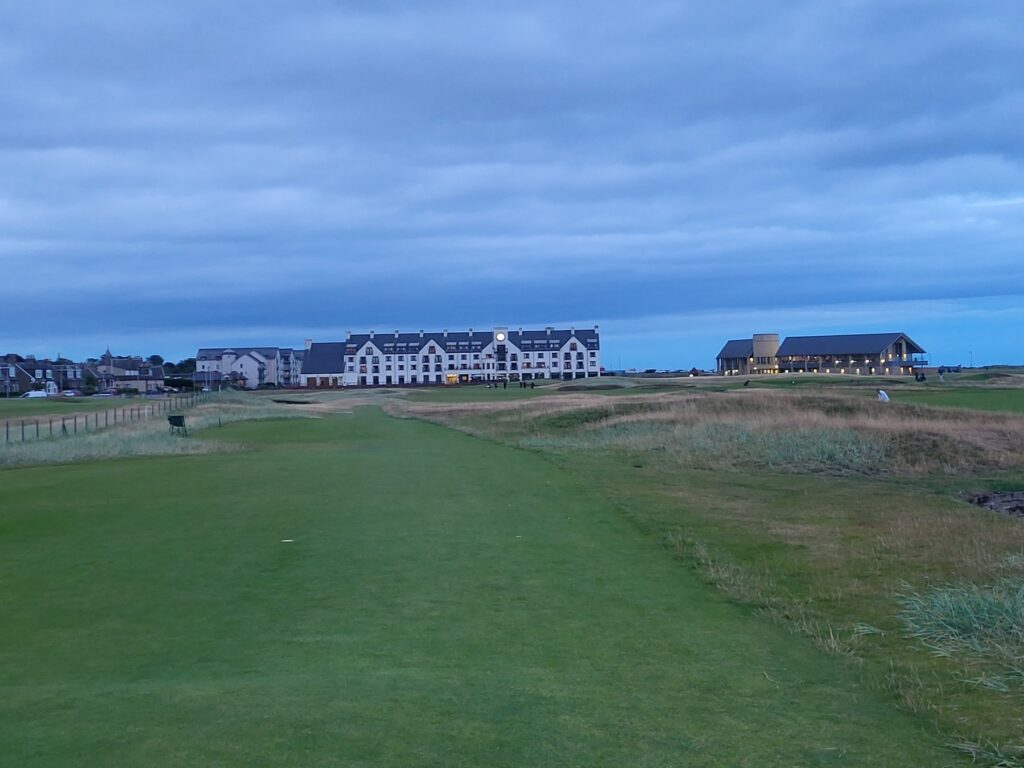
Carnoustie is the exception, and it is worth knowing. There is a station beside the course, which is why the 9th is called Railway. You can come off a train and be on the first tee in a few minutes. Almost nothing else on a Scotland itinerary works like that, so the train that gets you here will not get you to the next one.
Rough drives, and they are all longer than the map suggests because the roads are single carriageway for a lot of it:
Edinburgh to Carnoustie, about an hour and a half. St Andrews to Carnoustie, forty to forty five minutes, and you go over the Tay Road Bridge at Dundee. Dundee to Carnoustie, twenty five minutes. Carnoustie to Panmure, a few minutes up the road. Edinburgh to Turnberry, about two hours. Inverness to Royal Dornoch, about forty five minutes. Anything out on Kintyre or the islands is most of a day, so plan those as a stay rather than a stop.
Do not book two championship courses ninety miles apart on the same day. People do it, and they spend the trip in the car.
Airports, trains and the detail: how far Carnoustie is from St Andrews and Edinburgh.
What to bring
Waterproofs that actually work, top and bottom. Not a shower jacket.
Layers rather than one warm thing. You can get all four seasons inside an hour here, and you will be taking things off and putting them back on all day.
Two gloves at least, because a wet glove is useless and it will rain on you at some point.
A hat that stays on in wind.
You do not need twenty golf balls. There are no ponds at Carnoustie and you lose far fewer balls here than people expect. Leave the spares at the hotel. Scotland sells golf balls.
Quick answers
When is the best time of year to play golf in Scotland? July and August, if you are coming once and want the courses at their best. The links are running and the ground is fast. Those are also the busiest and dearest months, so late May and early September are the trade if you want more golf for less money.
Can you play Carnoustie in the winter? Yes, with a condition. The Links treat 1 November to 31 March as winter. In that window only the Burnside and the Buddon are open to play, the Championship course is not, and mats are used by everybody to protect the fairways. The Links provide the mat.
How far ahead do you need to book golf in Scotland? A year for a peak summer weekend at Carnoustie, Turnberry, Kingsbarns or Royal Dornoch, and six months for the shoulder season. The Old Course advance application opens in late August for the following year and is the single most important date in the calendar.
How much does it cost to play Carnoustie? In 2026 the Championship is £360 in high season and £249 in April. In 2027 it is £450 in high season and £342 from 29 March. The Burnside and the Buddon are £135 and £99 in 2026, and £144 and £105 in 2027.
How much is a caddie at Carnoustie? £80 per bag, with a gratuity on top. Most of the championship links are in the same bracket.
Do you need a handicap to play Carnoustie? The published limit is 28 for men and 36 for ladies. In practice I have never seen a visitor asked for a handicap certificate at Carnoustie. The Old Course is the one to take seriously, because you have to declare a handicap to enter the ballot at all.
Do you need a car for a Scotland golf trip? Yes. Most of the good links have no direct train line near them. Carnoustie is the exception, with a station beside the course, which is why the 9th is called Railway.
How far is Carnoustie from St Andrews and Edinburgh? Forty to forty five minutes from St Andrews over the Tay Road Bridge, an hour and a half from Edinburgh, and twenty five minutes from Dundee.
Green fees and booking terms are the clubs’ own. Carnoustie’s are on Carnoustie Golf Links’ green fees page and St Andrews’ are on standrews.com. They can change, so check before you book. Dollar figures are rounded at about $1.35 to the pound and move with the rate.
Before you play Carnoustie
The Carnoustie Caddie: How the Course Really Plays is all 18 holes the way I would give them to you on the bag. The wind, the bunkers that actually cost you shots, where the burns sit, and the club to hit standing on the tee.
Signed copies, posted from Carnoustie, inscribed to whoever you want. Or get it on Amazon.
Carnoustie, Answered · The best time of year to play · The Carnoustie Caddie: How the Course Really Plays
I am an independent caddie at Carnoustie and this site is not affiliated with Carnoustie Golf Links or with St Andrews Links Trust.